Licenses & Regulations
What a fishing license costs, and why
There is no national fishing license price because there is no national fishing license. Fifty states sell their own, price their own and spend the money on their own water. Here is how the bands run, what the tiers mean, and why the fee is the cheapest line in the trip budget.
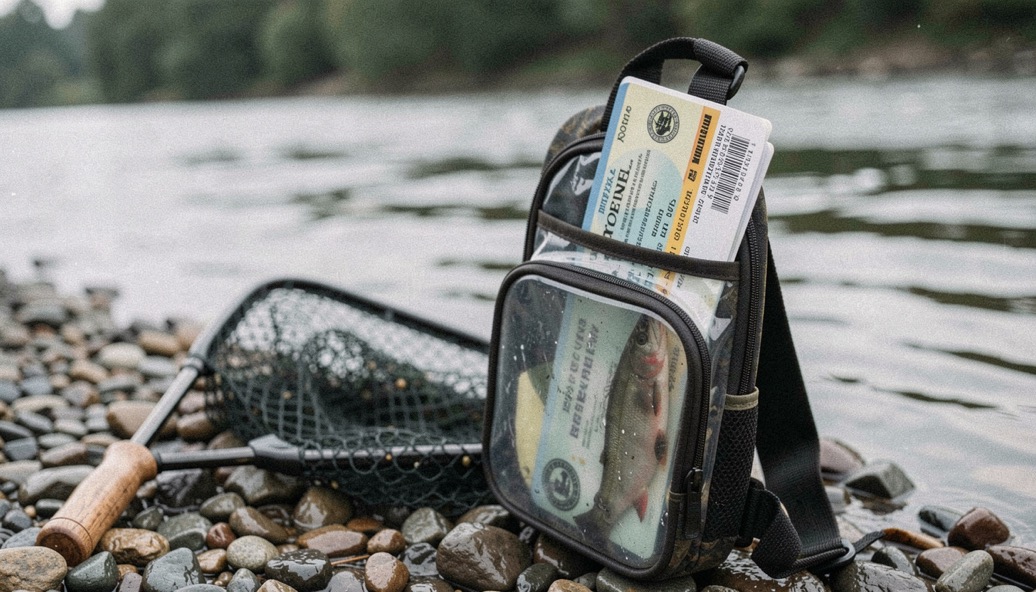
A fishing license costs what your state says it costs, which is the shortest accurate answer in this journal. There is no federal freshwater fishing license and no typical national figure; each state writes its own fee schedule, sells it through its own agency, and spends the revenue on its own fish and water. That single structural fact explains the price gaps between neighboring states, the resident and nonresident split, and why the endorsement that matters on one river does not exist across the line. What this page can do honestly is describe the bands: what typically runs where, and why the money is the best spent line in any trip budget.
The resident and nonresident split
Every state prices two audiences. A resident annual freshwater fishing license typically lands somewhere in the 25 to 45 dollar range in many states, with some under 20 and a few over 50. The nonresident version of the same license typically runs from roughly 50 up toward 100 dollars or more, because resident systems are subsidized by resident taxes that fund the agencies year round. Neither number is a ripoff; both are lower, adjusted for everything, than the fuel to the put in. If you fish one border river twice a year on opposite banks, you may simply need both states’ licenses, and the etiquette of shared water is on the access page.
The tiers and what they actually buy
Under the annual license sits a family of shorter and longer instruments, and choosing the right tier is its own small saving. The table gives the typical bands a first time buyer meets; treat every figure as a range to check, never a quote.
| Tier | Typical band | Best for |
|---|---|---|
| One day | About 10 to 20 dollars, more nonresident | The curious and the one trip a year |
| Short term, 3 to 7 day | About 20 to 40 dollars | Vacations that will fish twice |
| Annual, resident | About 25 to 45 dollars in many states | Anyone fishing more than three or four times |
| Annual, nonresident | About 50 to 100 dollars or more | The traveling angler’s fixed cost |
| Trout or salmon endorsement | Commonly about 10 to 25 dollars added | Required where special fisheries exist |
| Lifetime, age banded | From a few hundred dollars upward | The committed local, often the cheapest per year |
Salt water adds its own registry or license in most coastal states, typically cheaper than freshwater annuals and sometimes free with registration. Combination hunting and fishing licenses exist nearly everywhere and usually beat buying the two separately.
Where the money goes
License revenue is not a general tax. In most states it is dedicated to the fish and wildlife agency, and through the federal Sport Fish Restoration program, which is funded by fishing equipment excise taxes and returned to the states by formula, it leverages hatcheries, boat access, habitat work and the biologists who set the seasons this whole site reads. That is the honest answer to the angler who grumbles at the fee: the license is the membership card, and the stocking truck, the ramp and the creel survey are what it buys. An unlicensed fishing trip is not a saving; it is a withdrawal from the same account, plus a fine.
Buy early, carry proof, check endorsements
Three habits make the paperwork invisible. Buy the night before, online, because agency websites and license agents both close, and opening morning has no queue worth standing in. Carry proof the legal way: most states accept an electronic copy in an app or a saved file, some still want paper, and the booklet says which. And check endorsements before you rig up, because trout water, salmon water, some tailwaters and some lakes carry adds on the base license, and a warden’s conversation at the truck is the most expensive way to learn one.
The license day checklist
- Correct residency status chosen honestly; drivers license and state may disagree by definition.
- Right species endorsements added, trout and salmon where required.
- Proof saved offline, in the phone, in the vest, in the truck.
- Season dates and any special regulation water noted beside the license.
- Old licenses kept a year, for history and for draw records.
Mistakes the fee schedule punishes
The classic failures are status errors. Fishing a border river on the wrong bank, assuming a home license travels like a passport, which it does not. Buying resident by default after a move, when legal residency has its own definition. Skipping the endorsement on special regulation water. Fishing a free fishing day from a boat that requires something else, or on water where the free day does not apply. And assuming a license covers the people in the boat with you; it covers exactly one angler, and kids’ rules vary by state, some free, some not.
The decision, in one line
Fish more than four times a year: buy the annual, resident or nonresident, and stop doing math. Fish once on a trip: buy the right short term tier with the right endorsements. Fish a special regulation river: add the endorsement before you need it. The price is a known, banded, budgetable number, and the resource it funds is the reason any of the rest of this journal, the hatches, the currents, the release craft, exists to be read.