Ethics & Conservation
Catch and release practices that fish survive
Released is not the same as survived. The gap between the two is a short list of habits: barbless points, wet hands, a real net, ten seconds of air or less, and a revival that ends on the fish’s terms. Each habit has a reason attached.
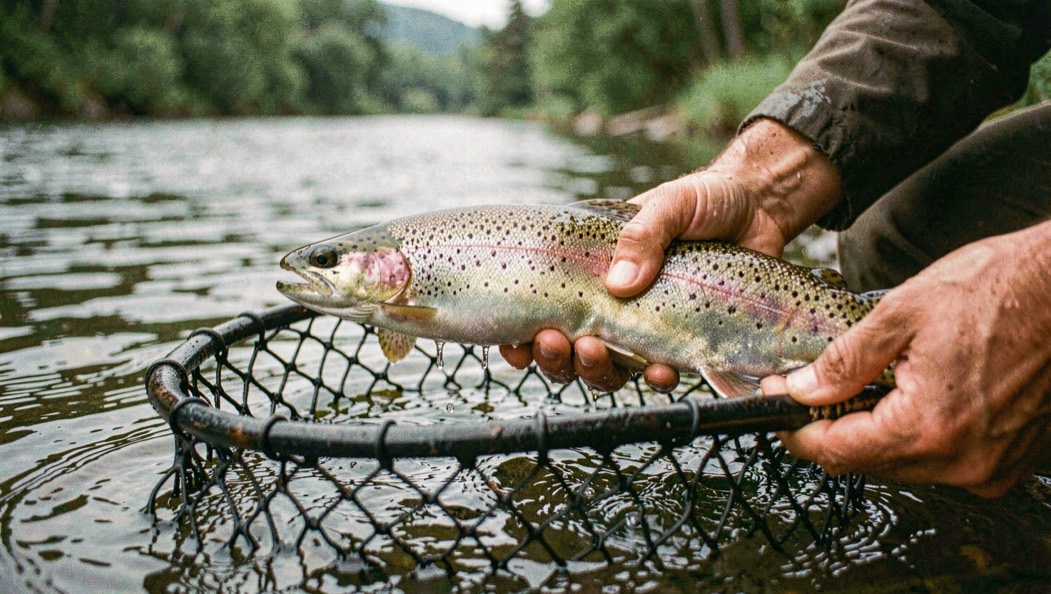
Catch and release works, which is why so many fisheries run on it, and it works because generations of anglers and fisheries biologists converged on a short list of handling rules that the fish demonstrably survive. Published studies on trout and similar fish generally report strong survival for properly released fish, with mortality concentrated in the predictable places: long fights, long air exposure, dry hands, deep hooked gear and warm water. Every rule on this page attacks one of those places, and every one has a reason you can explain to a beginner in one sentence.
Barbless: the decision made before the fish
Pinch the barb on every fly you tie on, with forceps, and the decision is made before the fish exists. A barbless hook penetrates faster, which means more solid hooksets on light tippets, and releases without tools, which cuts handling time to nearly zero. It loses a few fish a barb would have held, and most anglers who fish barbless for a season conclude the bargain favors them: the lost fish usually come off in the first seconds, before the fight is real. On water where treble hooks or bait rules apply, follow the water’s regulation, which the license page treats as the floor of ethics rather than its ceiling.
The ten second rule for air
Air is the budget that spends fish. A trout out of water holds its breath and accumulates an oxygen debt at the same moment its body weight, unsupported, strains its joints and organs. The working discipline is simple: keep the fish in the water until the photograph is staged, lift once, and get it back within ten seconds. Want a second angle, have the photographer ready before the lift. The fish that swims away instantly and the fish that flops on dry gravel for a minute are the same species having very different evenings, and the water temperature page explains why warm evenings shorten the budget further.
Nets, hands and the wet everything rule
A rubber mesh net is a release tool first and a landing tool second, and it earns its place on the gear budget page for exactly that reason. Knotted nylon nets scrape the protective slime coat that is the fish’s immune system; rubber does not. Hands stay wet, always, and a big fish is supported horizontally, one hand at the tail wrist, one cupped under the belly, never hung vertically by the jaw or gill plate, which turns a two pound fish into a lever against its own spine. On the bank, kneel; a fish released at standing height falls hard.
Hooks in deep: the counterintuitive move
A hook buried past the bend, in the throat or the gullet, is better left than excavated. Cut the tippet as close as the situation allows and release the fish with the hook in place; hooks held by machine commonly shed or dissolve far faster than the damage a removal attempt does. The exceptions are visual and quick: a hook in the lip or the mouth’s outer parts comes out with long forceps, one motion, barbless making it easy. Carrying those forceps is a checklist item.
| Practice | Reason it works |
|---|---|
| Barbless hooks, pinched or tied that way | Faster release, less tissue damage, shorter handling |
| Rubber, knotless net | Protects the slime coat; holds fish for in water unhooking |
| Wet hands, horizontal support | Keeps the slime coat; protects jaw and organs of heavy fish |
| Under 10 seconds of air | Limits oxygen debt; most assessed mortality concentrates here |
| Cut line on deep hooks, do not dig | Removal attempts kill more fish than swallowed hooks do |
| Revive facing upstream, leave on its kick | Oxygen flows over the gills; the fish sets its own departure |
| Above 65 F water, shorten everything | Warm water holds less oxygen; recovery slows sharply |
The revive ritual, done properly
Revival is not waving a fish around. Hold it upright facing upstream in water of normal speed, hands loosely around the tail wrist and under the belly, and let the river breathe for it. The fish will tell you when it is ready: it will load the tail and pull. Let that pull be the release, and do not chase the departure. A fish that tips over again after letting go comes back for another round of holding, and if it will not right itself after honest time, that fish needed fewer seconds of air an hour ago.
The release kit, small and mandatory
- Rubber bag net clipped where the landing hand reaches.
- Long forceps and nippers, for quick lip hooks and cut lines.
- Camera ready before the lift: settings checked, hands wet, fish wet.
- Thermometer, because the release rules tighten as the water warms.
- The discipline to end the day when the releases start coming back slow.
Mistakes that turn releases into losses
The standard failures stack up fast. The trophy grip, a heavy fish hung vertically by one hand for a photograph, which injures exactly the fish people most want to swim away. The photo marathon, thirty seconds of air per angle across six angles. The dry gravel landing, where slime and scale stay behind on the stones. Playing a fish to exhaustion on tackle too light for the water, a decision made hours earlier, per the budget page. And warm water afternoons, when every careful habit is a day late and the honest move is to quit, per the thermometer’s stop line.
The decision, stated once
Release fishing is a craft with a checklist, not a mood. Pinch the barbs at the vise, net with rubber, unhook in the water, photograph within ten prepared seconds, support horizontally, revive on the fish’s schedule, and let the thermometer decide whether today is a trout day at all. Do this and the fish you return are the ones the next angler catches, which is the entire quiet contract of the sport, and the reason the access page treats every bank as borrowed.