Ethics & Conservation
River access and etiquette: sharing the water
Access is the resource behind the resource, and it runs on customs more than laws. Where you may stand, how close is too close, who moves on a shared run, and how to not carry invaders in your wading felt: the unwritten rules, written down.
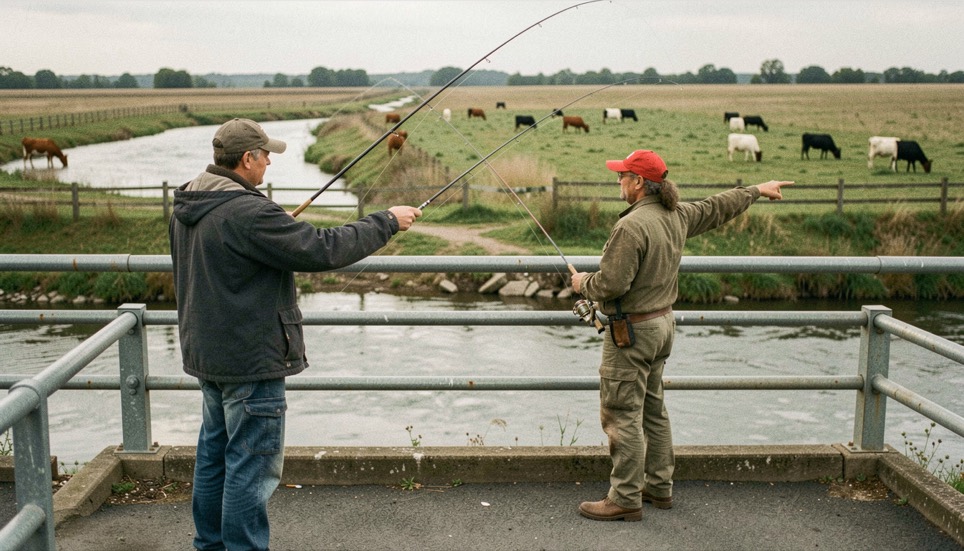
Every fishery in this journal exists inside a permission structure, and most of that structure is unwritten. A bridge pool is public in one state, private to the high water mark in another, and leased to a club in a third. What keeps water open is not signage; it is the accumulated courtesy of the people who use it well. This page writes down those customs: the access law basics worth knowing, the spacing rules nobody posts, the float and wade negotiation, and the cleaning habit that keeps invasives from hitchhiking in your gear.
Where you may legally stand
Access law is state law, and the differences are real. Many states recognize public ownership of the streambed where navigable, some run on the high water mark, some protect the adjoining landowner’s control to the water’s edge. The working method is not to memorize fifty statutes but to do three things: learn your own state’s rule once, from the agency or a current summary; use the established public points, bridge rights of way, wildlife areas, public easements, which are marked on agency maps and in the booklet the season calendar page teaches you to read; and treat any uncertain bank as private until someone with knowledge says otherwise. Asking permission costs two minutes. Losing a farm’s access costs a valley.
The landowner relationship
Countryside access survives on the farmer’s memory of the last angler, and that memory is written by small habits. Park where you were told, close the gate you opened, carry out everything including the tangle of line, and say hello on the way past rather than the way out. Offer a few of the day’s fish where take is legal, or a photograph where it is not. Never cross a field without permission even where the law might allow it, and never move a fence or a cattle panel. The anglers a landowner remembers fondly are the ones who asked, and asking once with a wave is cheaper than any lease.
Spacing: the rule nobody posts
On pressured water the custom is simple and universally violated by someone: never step into the water below or within a reasonable cast of an angler already working, and take the closest unoccupied water of the same quality rather than the best water regardless of who is near it. A pool fishes one party at a time in the polite world, and the rotation at famous runs moves in order of arrival, upstream bank fishing upstream, and so on. On a crowded river the question to ask a fellow angler is short and disarming: where are you headed, so I stay out of your way? Nobody has ever lost fish to that sentence.
| Situation | The custom |
|---|---|
| Another angler on the run you wanted | Take the next comparable water, not the next lie |
| A boat approaching your riffle | Each holds their line: wader keeps the seam, boat gives the bank or passes wide |
| Someone wading through your lane | Assume ignorance, say something kind before anything else |
| A fish hooked crosses your line | Reel in and let the fight happen; untangle after, never cut first |
| A gate, a cow, an electric fence | The landowner’s infrastructure outranks the fishing, always |
Float meets wade
The boat and the bank share every river in this journal, and the customs mostly resolve through speed and honesty. A drifting boat yields to the wading angler’s water, passing wide or holding off the seam until past; the wading angler yields the bank landing to a boat that needs it, and does not cast across a drifting angler’s line of travel. Nobody owns the run, everybody owns their wake and their backcast. The full phrase, Fish the water in front of you, covers about ninety percent of river conflict, and the remaining ten percent is settled by the first person who says good morning.
Do not carry invaders in your boots
The newest etiquette is biological. Didymo, New Zealand mudsnails, whirling disease and a growing list of aquatic hitchhikers travel on felt, mesh, nets, anchors and bilge water, and the standing guidance from fish and wildlife agencies is check, clean, dry: inspect gear and remove anything attached, rinse or soak as local guidance specifies, and let everything dry completely between waters. On waters with known infestations, follow the posted decontamination requirements without theater. The habit costs ten minutes and protects every page of this site, which is why the release page and this one share the same spine: the resource outranks the day.
The shared water checklist
- Access points and their rules confirmed on the map before wading.
- Permission asked where any doubt exists, gate etiquette observed.
- Spacing taken, rotation respected, good morning said first.
- Line scraps, leaders and lunch wrappers packed out, every time.
- Gear cleaned and dried between waters, per local guidance.
Mistakes that close water for everyone
The ledger of closed access reads short and bitter. Trespassing from a bridge pullout, so the pullout posts. Litter at the takeout, so the takeout locks. Cutting a fence, so the fence becomes a gate and the gate stays shut. Loud crowding at a famous pool, so the pool earns a list or a lease. And moving invaders between basins on dirty felt, so a rubber soled rule arrives for everyone. None of these are accidents of law; they are failures of courtesy, and courtesy is the one piece of gear on this site that never wears out.
The decision, in one sentence
Fish every piece of water as if the next angler’s season depends on your manners, because it does: take the next water, ask first, clean between waters, and pack out the day. That sentence, plus the release craft on the best practices page, is the whole conservation platform of this journal, and both cost nothing to carry.