Reading Water
Water temperature and trout: what to expect
A trout is a thermometer with fins. The same fish at 38 degrees and at 66 degrees behaves like two different animals, and a ten dollar stream thermometer explains more refusals than any fly pattern ever has.
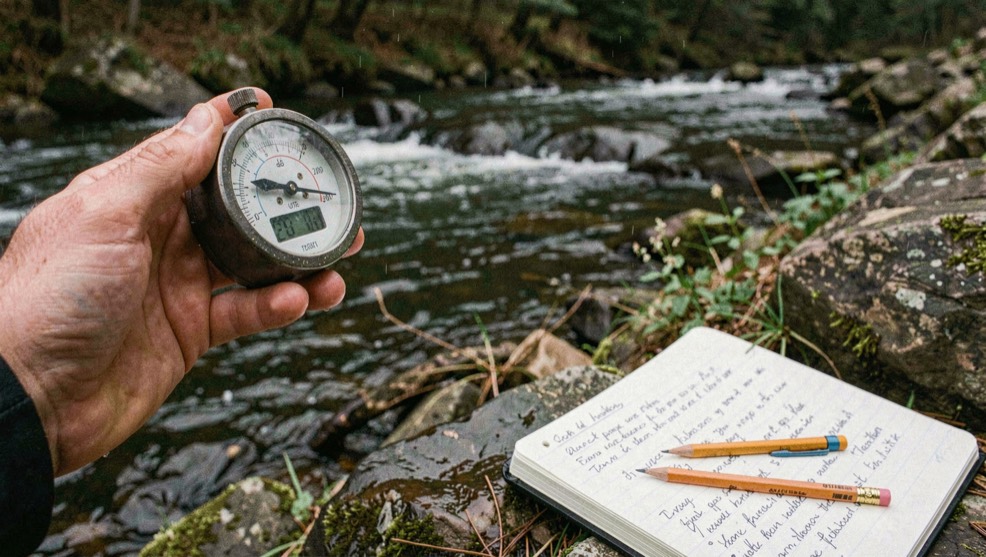
Trout are cold blooded in the literal sense: their body runs at the water’s temperature, and their entire schedule, feeding, holding, fighting, survives, hangs off that number. This is why serious anglers carry a stream thermometer and why this journal treats one as gear rather than a gadget. The bands below are working ranges drawn from fisheries guidance and long angling practice; individual rivers and species shift them a few degrees, so treat the table as a map with a legend, not a contract.
The bands, and what each one asks of you
| Water temp | What the fish are doing | How to fish it |
|---|---|---|
| Below 40 F | Metabolism barely idles; fish hold in slow, deep water | Small flies, slow and deep, fish the warmest midday hours |
| 40 to 50 F | Feeding windows open with sun and afternoon warmth | Focus effort midday, work the slower seams thoroughly |
| 50 to 65 F | The prime band: active, spread out, willing | Fish hard, all methods open, hatches at their schedule |
| 65 to 70 F | Oxygen stress begins; fish fight shorter and recover slower | Fish early only, land fast, extend the release rituals |
| Above 70 F | Sustained stress; some states close or recommend stopping | Rest the trout, switch to warm water species, check closures |
Two structural notes sharpen the table. Tailwaters, the cold flows below dams, run cooler in summer and warmer in winter than freestone rivers, which is why they fish well in the shoulder seasons. And a river is not one temperature: side channels, spring seeps and pond inlets all run their own bands, which is one more way the features in the currents page become fish finders.
Reading temperature like a river reading
Take the temperature where you will fish, a foot under the surface in moving water, not at the truck or in your hand. Write the number and the hour down; the log becomes predictive within a season. Watch the trend as hard as the number, because a river falling from 68 toward 60 fishes better every morning, and one climbing through 66 toward 70 is a river to leave alone by afternoon. On tailwaters, learn the release schedule, because a generation of cold water arriving changes the band within hours, and the currents page explains where the new cold collects first.
Warm water is the ethical edge
The 70 degree line is where reading water becomes ethics. Warm water carries less dissolved oxygen, so a trout hooked there burns through its reserve quickly and recovers slowly no matter how careful the release. Many states post voluntary stop fishing advisories or outright hoot owl closures in hot spells, and the practice this journal backs is simpler than any regulation: when the thermometer crosses the line, let the trout alone and point the day at bass, carp or panfish, which are built for warm water and fight happily in it. The catch and release page’s handling rules exist for normal conditions; at the warm edge, avoidance is the practice.
The thermometer habit
- Measure at fishing depth in moving water, and log number plus hour.
- Recheck at midday on any day starting above 60 F.
- Treat 65 F as the caution line for handling, 70 F as the stop line for trout.
- On tailwaters, pair the log with the dam release schedule.
- Let the trend, not one reading, plan the afternoon.
Species shift the bands a little
The table describes trout in general, and each species bends it. Brook trout favor the coolest end of every band and fade first in warm spells, brown trout tolerate slightly warmer water and feed later into the evening, and rainbows sit between, which is why the same run can produce three different species on three different hours of the same day. Warm water species such as smallmouth bass and carp pick up exactly where the trout bands end, and their range overlaps enough that a warm July afternoon can be a trout dawn and a bass dusk on the same water. Know which fish you are actually targeting before the thermometer talks you out of the day.
Mistakes temperature explains
Half the winter’s mysteries dissolve at the thermometer. Fishing dry flies at 42 degrees, when the fish are stacked in winter holding water eating lazily deep. Giving up at 10 in the morning on a fall day whose feeding window opens at one. Blaming the pattern during a warm spell when every fish hooked fights for five seconds and sulk, the classic oxygen stress signature. Crowding a spring creek’s cold refuges in August heat, hammering the very fish that cannot leave. And ignoring a rising river’s temperature drop after a cold rain, which reorganizes every lie in the run.
The decision, in one habit
Clip a thermometer to the net or the pack, dip it at the first stop, and let the number choose the plan: below 50, slow and deep through midday; 50 to 65, fish everything with confidence; 65 to 70, dawn only with extended releases; over 70, give the trout the day. Pair the habit with the currents map and the season calendar for the dates, and the year stops being a lottery. Temperature is the river’s clock, and it runs whether or not anyone reads it.